
The New Standard for Dental Cybersecurity Training in the Age of AI
Apr 28, 2026 
To date, I have trained more than 50,000 dental professionals on privacy, cybersecurity, and safe technology use.
And if there is one thing I know for sure, it is this: awareness is not the finish line. It is the starting point.
Dental teams already have a lot on their plates. They are managing patients, schedules, insurance, records, payments, software, messages, and now AI tools too. They do not need fear-based training or generic tech lectures. They need practical, dental-specific skill-building that helps them recognize risk and respond wisely in real life.
Cybersecurity is no longer just something "IT handles."
It is becoming an essential life skill: knowing how to use technology while protecting yourself, your patients, your team, your contacts, and the people who trust your practice.
That is the new standard for dental cybersecurity training in the age of AI.
And frankly, it is overdue.
The direct answer: the best dental cybersecurity training builds skills, not just awareness
The best dental cybersecurity training is dental-specific, practical, modular, scenario-based, and supported by experienced professionals who understand the realities of dental practice.
It should help your team answer everyday questions like:
- Is this email safe to open?
- Should I send patient information this way?
- Is this AI tool appropriate for patient-related work?
- What should I do if something feels suspicious?
- Who do I report this to, and how quickly?
That is very different from giving staff a generic online video once a year and calling it done. A certificate has value only when the learning behind it is meaningful, current, and relevant. Otherwise, it is a digital gold star with a weak Wi-Fi signal.
For a practical example of dental-specific training, see Myla's Cybersecurity Essentials for Dental Teams.
Cybersecurity guidance increasingly emphasizes that people need regular, practical reinforcement. CISA recommends training employees to recognize phishing, keeping teams informed about emerging threats, and not relying on once-a-year training alone. NIST's Cybersecurity Framework 2.0 also includes awareness and training as part of managing cybersecurity risk across organizations.
Why basic awareness is not enough anymore
Awareness tells people that risk exists. Skill-building helps them know what to do about it.
That difference matters. A dental team member may be aware that phishing exists and still click a convincing message that appears to come from a lab, software vendor, courier, payment platform, insurance provider, colleague, or patient. Modern scams are not always obvious. Many are personalized, urgent, and written well enough to bypass the old "just look for spelling mistakes" advice.
AI adds another layer. It can make fake messages, fake voices, fake documents, and fake requests look more convincing. It also creates new privacy questions for dental practices: what information can safely be entered into an AI tool, what should never be entered, and how should the practice evaluate new technology before using it?
NIST's AI Risk Management Framework was designed to help organizations manage risks connected to AI systems and incorporate trustworthiness considerations into AI design, use, and evaluation. For dental teams, the plain-language takeaway is simple: AI is useful, but it needs guardrails.
That is why dental cybersecurity training must evolve from awareness to skills.
For foundational context, you can also read Dental Cybersecurity: What Your Practice Needs to Know.
What the best dental cybersecurity training includes
1. Dental-specific context
Generic cybersecurity training can teach basic ideas. It usually cannot explain what those ideas look like inside a dental practice.
Dental teams work with patient health information, payment data, insurance details, appointment systems, imaging platforms, referral workflows, vendor portals, email, texts, phones, and cloud tools. Training needs to reflect that environment.
A dental-specific program should use examples that feel familiar:
- a suspicious email from a dental supply vendor
- a fake request to change payment information
- a patient message with an unusual attachment
- an AI tool being used to draft patient communication
- a team member unsure how to report a privacy concern
- a practice manager trying to document training for compliance or insurance
When training feels relevant, people pay attention. When it feels like a generic corporate checkbox, they mentally move on to the hygiene room schedule. Understandable, but not ideal.
2. Modular learning that builds over time
Great training should not dump everything on the team at once.
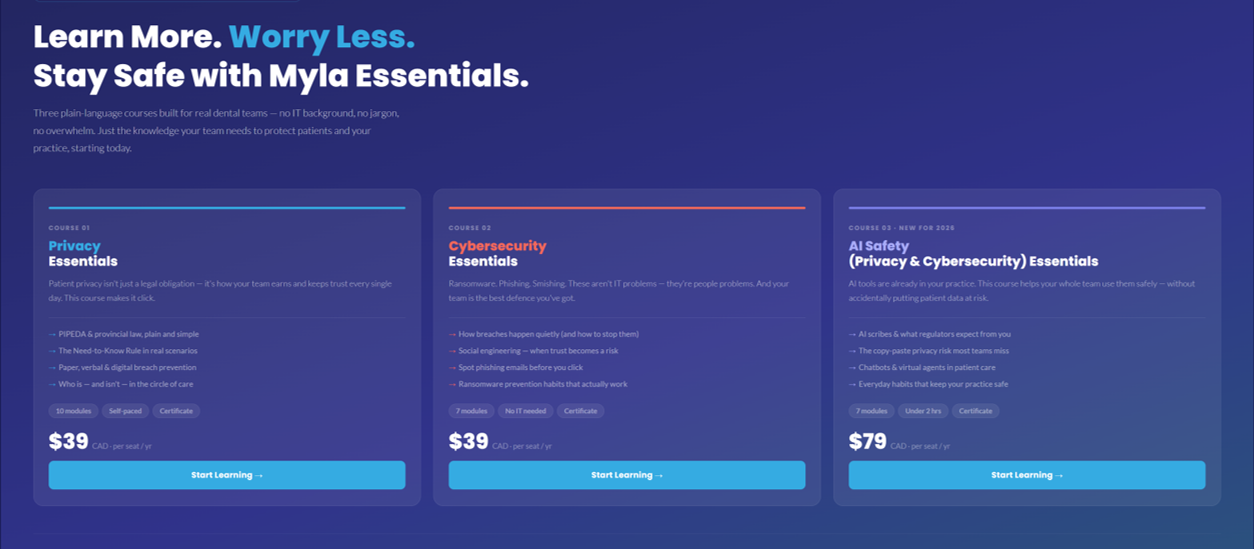
Dental teams learn best when information is organized into clear, manageable modules. Each module should build on the last, moving from essential concepts to more advanced skills. This is especially important as technology becomes more complex.
A strong training pathway might include:
- cyber hygiene basics
- phishing and social engineering
- passwords, passphrases, and multi-factor authentication
- safe email and messaging habits
- privacy and patient information handling
- device and software safety
- ransomware readiness
- AI privacy and cybersecurity risks
- incident reporting and response basics
- leadership responsibilities and documentation
This approach helps teams grow steadily instead of being overwhelmed. It also supports ongoing learning, which is critical because the threats, tools, and workflows keep changing.
3. Bite-sized microlearning
Dental practices are busy. Training that requires everyone to disappear for hours is hard to schedule and even harder to repeat.
Bite-sized learning works better because it respects the reality of practice life. Short lessons, quick refreshers, and focused learning moments help teams absorb and apply information without derailing the day.
The goal is not to turn every dental professional into an IT technician. The goal is to help every team member become safer, calmer, and more confident when using technology.
4. Scenario-based learning
People do not build judgment by memorizing definitions. They build judgment by practicing decisions.
That is why scenario-based learning is essential. Instead of only saying "watch out for phishing," strong training walks the learner through realistic situations and asks: what would you do next?
For example:
- A message says a patient's insurance file is attached, but the sender looks slightly off.
- A caller claims to be from the practice management software company and asks for remote access.
- A team member wants to paste a patient note into an AI tool to rewrite it.
- A dentist receives an urgent payment-change request from a supplier.
- A front desk team member notices a strange login alert.
These are the moments where training proves its worth. The best training gives people safe practice before they face the real thing.
5. Interactive and gamified elements
Good training should not feel like punishment with a progress bar.
Interactive content, knowledge checks, branching scenarios, quizzes, and gamified learning can help keep people engaged. More importantly, they help learners practice retrieval: remembering what to do when it matters.
For dental teams, that means moving from "I watched the video" to "I can spot the risk, make a safer choice, and report it properly."
That is the difference between passive awareness and practical skill.
6. Certificates, credentialing, and documentation
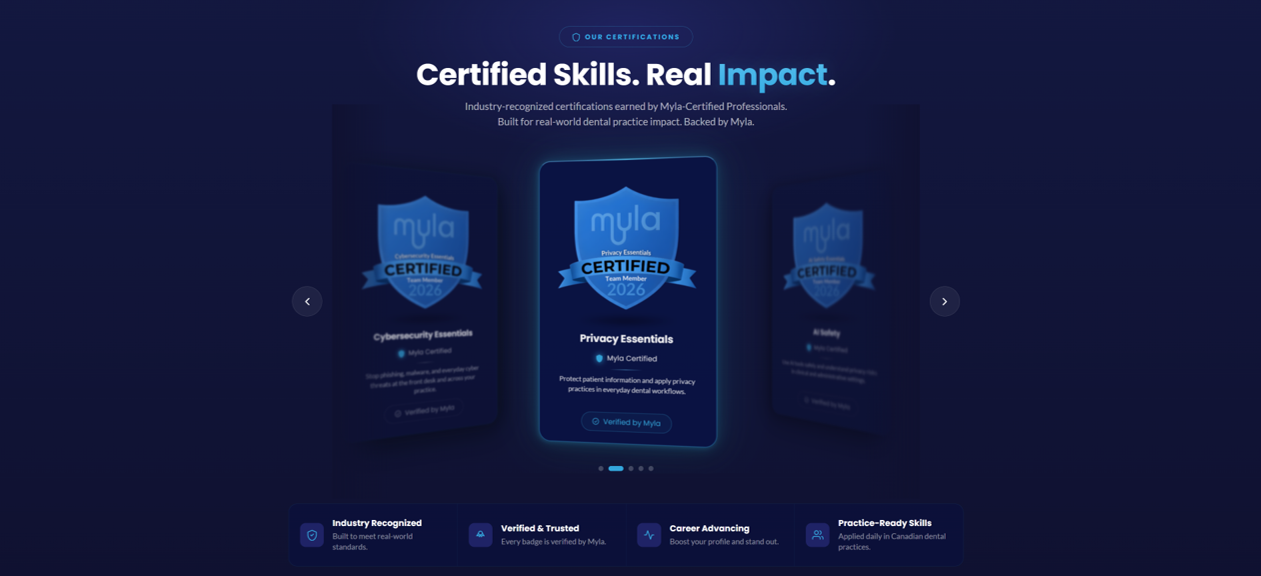
Training should provide proof. Dental practices may need documentation for internal accountability, privacy compliance, risk management, insurance conversations, or leadership oversight.
A strong program should make it easy to show:
- who completed training
- what topics were covered
- when training was completed
- what certificate or credential was issued
- what follow-up or advanced learning is available
Certificates matter. But they should represent real learning, not just a completed click-path.
7. Support from experienced professionals
Even the best course content cannot answer every practice-specific question. Great training should come with access to people who understand the subject and the setting.
That is one of the reasons Myla was built as more than a generic training portal. The Myla team brings together deep experience across dental operations, dental IT, cybersecurity, privacy, AI, education, and clinical dentistry. That matters because dental teams do not work in theory. They work in real practices with real patients, real deadlines, and real risk decisions.
Myla's support model includes perspective from:
- a dental operations specialist
- dental IT and certified cybersecurity expertise
- privacy and AI education experience
- a retired dentist
- experienced trainers who understand how dental teams learn
That combination helps turn training into practical guidance. The goal is not just to tell teams what risk looks like. The goal is to help them understand what safer work looks like inside a dental practice.
Why trainer experience matters
A training platform can deliver content. An experienced trainer can create understanding. There is a difference.
When someone has trained tens of thousands of dental professionals, they start to see patterns. They hear the questions teams actually ask. They know where people get stuck. They understand that privacy, cybersecurity, and AI safety are not separate boxes. In a dental practice, they overlap constantly.
For example, a question about AI may also be a privacy question. A question about email may also be a phishing question. A question about software access may also be a cybersecurity and compliance question.
That is why dental cybersecurity training should be developed and supported by people who understand dental operations, privacy, cybersecurity, AI, and education, not just one of those areas in isolation.
What the old model gets wrong
The old model of cybersecurity training often looked like this:
- Buy a generic online course.
- Ask the team to complete it once a year.
- Download certificates.
- Hope everyone remembers what matters later.
Hope is lovely in greeting cards, but t is not a cybersecurity strategy.
Static training created at one point in time can become stale quickly. Threats change. AI tools change. Software changes. Attack techniques change. Regulatory expectations and insurance questions can change too.
Training has to keep pace. That does not mean overwhelming the team every week. It means building a learning system that can update, reinforce, and expand as the digital environment changes.
The Myla model: practical, dental-specific, and built for the AI era
Myla's approach is designed around a simple belief: dental teams are capable of being a strong line of defense when training is practical, respectful, and relevant.
The Myla model focuses on:
- dental-specific cybersecurity, privacy, and AI training
- modular learning pathways
- bite-sized lessons and microtraining
- scenario-based decision practice
- interactive and gamified learning elements
- certificates and credentialing
- support from experienced professionals
- continuous improvement as technology and risk evolve
This is where the SAFE Framework™ fits naturally. Dental teams need training that helps them slow down, assess risk, follow safe processes, and escalate concerns when something does not feel right.
That is not fear-based training. That is confidence-based training.
This is also why Myla is being built as a broader Myla Training Hub rather than a single static course.
What dental practices should look for before choosing training
Before choosing dental cybersecurity training, ask these questions:
- Was this built for dental practices, or is it generic workplace cybersecurity content?
- Does it address privacy, cybersecurity, and AI together?
- Does it build skills gradually, or only deliver one-time awareness?
- Does it use realistic dental scenarios?
- Is the content updated as threats and technology change?
- Does it include certificates or credentialing?
- Can the practice document completion?
- Is support available from people with real dental and cybersecurity experience?
- Does the training help the team know what to do, not just what to avoid?
If the answer to most of those questions is no, it may not be the right fit for today's dental environment.
The best dental cybersecurity training in the age of AI is not a one-time checkbox. It is an ongoing skill-building system.
It teaches people how to think, pause, verify, report, and use technology safely. It respects the pace of dental practice. It gives teams practical examples they recognize. It supports leaders with documentation. And it keeps evolving as technology changes.
Most importantly, it helps dental professionals protect themselves, their patients, their coworkers, and the people who trust their practice.
That is the new standard, and it is exactly why Myla exists.
If your practice wants a focused starting point, Myla also offers a free Ransomware Prevention - Defensive Tactics Crash Course. For practice-specific questions or support, you can connect with Myla.
Frequently Asked Questions
What makes dental cybersecurity training different from regular cybersecurity training?
Dental cybersecurity training is built around the real tools, workflows, patient information, privacy obligations, and communication patterns used in dental practices. Generic training may explain cyber concepts, but dental-specific training helps teams apply those concepts in their actual work.
Is cybersecurity awareness training enough for dental teams?
Awareness training is important, but it is not enough on its own. Dental teams need practical skill-building, realistic scenarios, repetition, and clear reporting processes so they know what to do when something suspicious happens.
Why does AI change cybersecurity training for dental practices?
AI can make scams more convincing and can create new privacy risks if patient or practice information is entered into tools without proper safeguards. Dental teams need training on safe AI use, privacy boundaries, and how to recognize AI-enhanced deception.
How often should dental teams receive cybersecurity training?
Dental teams should receive regular training and reinforcement, not just one annual course. The exact schedule depends on the practice, but cybersecurity guidance supports ongoing updates and reminders as threats change.
What should a dental practice look for in a cybersecurity training provider?
Look for dental-specific content, experienced instructors, privacy and AI coverage, scenario-based learning, certificates, documentation, and ongoing support. The provider should understand dental operations as well as cybersecurity.

About Anne Genge
Anne Genge is the founder of Myla Training Corp and a dental/medical privacy, AI, and cybersecurity educator. She has more than 30 years of dental operations and technology experience and has trained more than 50,000 dental professionals in cybersecurity, privacy, and safe technology use. Anne holds advanced training and certifications in privacy, AI and law, and healthcare cybersecurity, and is known for making complex risk topics practical, calm, and understandable for busy dental teams.
Learn More. Worry Less. Stay Safe.™
Sources
- CISA: Teach Employees to Avoid Phishing. Supports regular phishing training, reinforcement, and employee updates between trainings. — https://www.cisa.gov/audiences/small-and-medium-businesses/secure-your-business/teach-employees-avoid-phishing
- NIST: The NIST Cybersecurity Framework (CSF) 2.0. Supports cybersecurity risk management and awareness/training as part of organizational cybersecurity outcomes. — https://www.nist.gov/publications/nist-cybersecurity-framework-csf-20
- NIST: Artificial Intelligence Risk Management Framework (AI RMF 1.0). Supports AI risk management and trustworthiness considerations for organizations using AI systems. — https://www.nist.gov/publications/artificial-intelligence-risk-management-framework-ai-rmf-10
- Office of the Privacy Commissioner of Canada: PIPEDA breach reporting and safeguards guidance. Supports the privacy and breach accountability context for Canadian organizations handling personal information. — https://www.priv.gc.ca/en/privacy-topics/privacy-breaches/respond-to-a-privacy-breach-at-your-business/gd_pb_201810/
- Myla Training Corp: Myla homepage / Training Hub positioning, 50,000+ dental professionals trained, and dental training ecosystem language. — https://www.mylatraining.com/
- Myla Training Corp: Cybersecurity Awareness Training for Dental Practices / Cybersecurity Essentials for Dental Teams page. — https://myla.training/cybersecurity-awareness-training-for-dental-practices/
- Myla Training Corp: About page describing Myla, founder Anne Genge, and team/training focus. — https://myla.training/about/
- Myla Training Corp: Connect page with Anne Genge credentials and consultation pathway. — https://myla.training/connect/
Train Your Team to Spot AI Risks Today