The 25-Year-Old Privacy Law Many Dental Practices Still Overlook
Jun 18, 2026Does Canadian Privacy Law Require Privacy and Security Training for Dental Teams?
A dental practice can buy strong software, hire good IT support, and still have a breach begin with one ordinary moment: a team member clicks a convincing link, opens a fake attachment, sends patient information to the wrong person, or uses a tool without realizing where the data goes.
That is not because dental teams are careless. It is because cybercriminals know something very important: people are busy, helpful, and under pressure. In other words, people are not the weakest link. They are the most targeted link.
The good news is that people can also become one of the strongest safeguards in the practice. That is where privacy and security awareness training fits.
For Canadian dental practices, training is not just a nice extra or a once-a-year compliance chore. It is part of what privacy law expects, and it is one of the quickest, most practical, and usually least expensive ways to reduce risk across the whole practice.
The direct answer: yes, training is part of Canadian privacy compliance
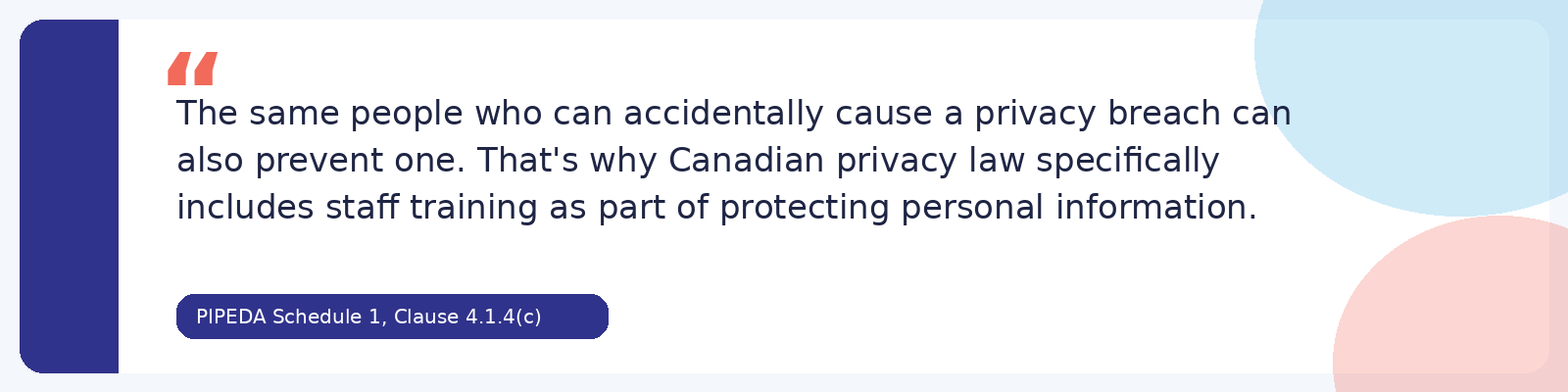
PIPEDA, Canada’s federal private-sector privacy law, includes a clear staff training requirement under Schedule 1, Principle 1 - Accountability. It says organizations must implement policies and practices to give effect to the privacy principles, including “training staff and communicating to staff information about the organization’s policies and practices.”
That matters because dental practices do not just need a privacy policy sitting in a binder or saved somewhere nobody opens. The practice needs staff to understand what the policy means in real life: at the front desk, in the operatory, in email, in text messages, in chart access, when using cloud software, and when something feels “off.”
PIPEDA also requires safeguards appropriate to the sensitivity of the information, and personal health information is highly sensitive. The safeguards principle says personal information must be protected against loss, theft, unauthorized access, disclosure, copying, use, or modification, and that employees must be made aware of the importance of maintaining confidentiality.
But this is bigger than privacy law
The legal requirement is important. It gives practice owners a clear compliance reason to train the team. But the stronger business reason is this: most dental cyber and privacy risk touches people before it touches technology.
Cybercriminals often do not start by attacking a firewall. They start by attacking attention. They send a fake invoice. They impersonate a supplier. They pretend to be a courier, a bank, a software vendor, a patient, a colleague, or even the dentist. They rely on one rushed click, one reused password, one mistaken disclosure, or one moment of uncertainty.
The Canadian Centre for Cyber Security says human error remains an element of too many cybersecurity incidents and recommends employee awareness training as a first line of defence for organizations. Its baseline controls for small and medium organizations specifically recommend training employees on practical issues such as identifying malicious emails and links, using approved software, safe internet use, and safe social media use.
That is exactly the dental reality. A practice is full of good people doing fast, high-trust work. Training helps turn those people into a detection system: someone who pauses before clicking, questions a strange request, reports a suspicious message, and knows how to protect patient information before a small mistake becomes a reportable breach.
The human side is not the problem. It is the opportunity.
Cybersecurity conversations often make staff feel blamed. That is not helpful, and it is not accurate. A team member who clicks a convincing phishing email is not the villain. The criminal who designed it is.
A better way to think about privacy and security awareness training is this: if attackers depend on humans to open the door, then trained humans are one of the best ways to keep the door closed.
Verizon’s 2024 Data Breach Investigations Report found that the human element was involved in 68% of breaches. The report describes the human element as a clearer metric for what security awareness can affect, excluding malicious insider misuse. That is a useful point for dental practices: the goal is not to make people perfect. The goal is to reduce the predictable mistakes and social engineering tricks that criminals use because they work.
This is why training is not “extra.” It is a control. It supports privacy compliance, cybersecurity, patient trust, and practice continuity at the same time.
What privacy and security awareness training should help dental teams do
Good training should not drown staff in legal language or technical jargon. Dental teams do not need to become cybersecurity analysts. They need to know what matters most in the situations they actually face.
Effective dental privacy and security awareness training should help the team:
- Recognize phishing, smishing, fake invoices, fake login pages, and suspicious links.
- Understand when patient information can and cannot be shared.
- Avoid sending personal health information through unsafe channels.
- Know what to do if information is sent to the wrong person.
- Use strong passwords and multi-factor authentication properly.
- Recognize risks in personal devices, public Wi-Fi, cloud tools, and AI tools.
- Report mistakes quickly without fear or shame.
- Understand why privacy policies matter in everyday dental workflows.
- Provide documented proof that training occurred.
That last point matters. If a complaint, breach, insurance review, or regulator question ever comes up, “we told people to be careful” is not the same as documented training. Documentation shows that the practice took the human side of privacy and security seriously.
Provincial health privacy laws still matter
PIPEDA is an important federal law, but dental practices also need to consider provincial and territorial privacy requirements, especially laws that specifically govern personal health information.
The Office of the Privacy Commissioner of Canada explains that some provinces have private-sector privacy laws that may apply instead of PIPEDA in many circumstances, and that several provinces have health information laws considered substantially similar to PIPEDA for personal health information. The OPC also notes that more than one privacy law can apply, and an organization may need to comply with both depending on the activity.
For dental practices, that means the exact legal answer may depend on the province or territory, the type of information, and the specific activity. For example, Ontario dental practices must consider PHIPA. Alberta, British Columbia, Quebec, New Brunswick, Newfoundland and Labrador, Nova Scotia, and other jurisdictions may have their own privacy or health information requirements that are relevant to dental care.
The practical takeaway is simple: do not stop at “What does PIPEDA say?” Ask, “What privacy and health information laws apply to our practice, and can we show that our team was trained on the rules that apply to them?”
Why training is often the fastest win
Dental practices often assume cybersecurity improvement means expensive technology projects. Sometimes technology upgrades are necessary. But training is different: it can be rolled out quickly, applies to every role, supports legal accountability, and immediately improves how the team handles everyday risk.
Training helps protect the practice because it reaches the moments technology cannot fully control:
- the front-desk decision to verify a suspicious request before sending records;
- the hygienist who notices a strange login prompt;
- the treatment coordinator who questions a payment-change email;
- the office manager who knows what to document after a privacy incident;
- the associate dentist who pauses before putting patient information into an AI tool.
Security software matters. Policies matter. Backups matter. IT support matters. But none of those replace a trained team. In a dental office, people are where privacy and security become real.
What “good enough” should look like for a dental practice
A practical dental privacy and security awareness program should include:
- Training for every team member, including dentists, hygienists, assistants, front desk, managers, contractors, and new hires.
- Annual refresher training, with updates when laws, tools, or threats change.
- Dental-specific scenarios, not generic corporate examples.
- Clear breach and incident reporting steps.
- Coverage of both privacy and cybersecurity, because patient information is at risk in both.
- Proof of completion, such as certificates, logs, or training records.
- A blame-free reporting culture, so people report quickly instead of hiding mistakes.
That is the sweet spot: not fear, not legal overwhelm, not “here is a 47-page policy, good luck.” Just clear, relevant training that helps the team protect patients and the practice.
A simple example
Imagine a front-desk team member receives an email that appears to be from a patient asking for records to be sent to a new address. The message looks polite and urgent. Without training, the team member may simply want to help and respond quickly.
With training, they pause. They verify the request through an approved process. They avoid sending personal health information to an unconfirmed address. If something seems suspicious, they know who to tell.
That is not a dramatic Hollywood cybersecurity moment. No hoodies. No green code. Just one trained person making one better decision. In real practices, that is often where safety lives.
The bottom line
Canadian privacy law gives dental practices a strong reason to train staff. Cybersecurity reality gives them an even stronger one.
PIPEDA says organizations must train staff and communicate privacy policies and practices. Provincial privacy and health information laws may also apply. The Canadian Centre for Cyber Security recommends employee awareness training as a first line of defence. Verizon’s breach research shows why: the human element remains involved in a large share of breaches.
For dental practices, privacy and security awareness training is one of the quickest ways to strengthen the whole practice. It helps protect patients, supports compliance, reduces preventable mistakes, and gives the team confidence to recognize risk before it turns into a breach.
Because the goal is not to make people afraid of technology. The goal is to help good people make safer decisions in a world where cybercriminals are counting on them not to.
FAQ
Does Canadian privacy law require dental practices to train staff?
Yes. PIPEDA Schedule 1, clause 4.1.4(c), says organizations must implement policies and practices that include training staff and communicating information about the organization’s privacy policies and practices. Provincial privacy or health information laws may also apply depending on the jurisdiction and circumstances.
Is this privacy training or cybersecurity training?
For dental practices, it should be both. Privacy training explains how personal and personal health information must be collected, used, disclosed, retained, and protected. Cybersecurity awareness training helps staff recognize threats such as phishing, credential theft, unsafe links, unsafe software use, and risky AI or cloud tool behaviour. The two work together because cyber incidents often become privacy breaches.
How often should dental teams complete training?
At minimum, training should be provided during onboarding and refreshed regularly. Annual training is a practical baseline, with updates when laws, software, workflows, or cyber threats change. Practices should keep proof of completion.
Do dentists themselves need training, or only employees?
Dentists, owners, associates, managers, employees, contractors, and anyone with access to patient or practice information should be trained. Privacy and security risk does not stop at job title. Very inconvenient, but true.
Why is documented training important?
Documentation helps show that the practice took reasonable steps to train the team. If there is a complaint, breach, insurance review, or regulator question, training records can help demonstrate accountability and due diligence.
Sources
- Government of Canada, Justice Laws Website. Personal Information Protection and Electronic Documents Act, Schedule 1, clauses 4.1.4 and 4.7. https://laws-lois.justice.gc.ca/eng/acts/P-8.6/page-7.html
- Office of the Privacy Commissioner of Canada. PIPEDA compliance and training tools. https://www.priv.gc.ca/en/privacy-topics/privacy-laws-in-canada/the-personal-information-protection-and-electronic-documents-act-pipeda/pipeda-compliance-help/pipeda-compliance-and-training-tools/
- Office of the Privacy Commissioner of Canada. Provincial laws that may apply instead of PIPEDA. https://www.priv.gc.ca/en/privacy-topics/privacy-laws-in-canada/the-personal-information-protection-and-electronic-documents-act-pipeda/r_o_p/prov-pipeda/
- Canadian Centre for Cyber Security. Baseline cyber security controls for small and medium organizations, section 3.6 Provide Employee Awareness Training. https://www.cyber.gc.ca/en/guidance/baseline-cyber-security-controls-small-and-medium-organizations
- 2024 Data Breach Investigations Report. https://www.verizon.com/business/resources/reports/2024-dbir-data-breach-investigations-report.pdf
Train Your Team to Spot AI Risks Today