Dental AI Essentials: The Myla PAUSE Protocol™: A Practical Framework for Dental Teams
May 16, 2026I have noticed a problem. Maybe you have noticed it too.
Everyone is jumping into AI.
Dental teams are trying it. Practice owners are curious about it. Vendors are building it into software. Staff are using it to draft messages, summarize information, write policies, create patient education materials, and speed up daily tasks.
And honestly? I understand why.
AI can be incredibly useful.
But here is the part we cannot ignore: most people are using AI before they fully understand the rules.
Prompts are being entered without enough thought about privacy. Outputs are being copied without enough review. Different users are getting different answers from the same tool. Some responses sound polished but are completely wrong. We are also seeing real-world consequences when people rely on AI-generated content without checking it carefully.
In dentistry, that matters.
We are not just working with ordinary information. We are working with patient information, clinical judgment, regulatory obligations, professional accountability, and trust.
AI is not like switching from film to digital X-rays.
It is not just another tool. It changes how information is created, reviewed, stored, shared, and acted on.
That means dental practices need more than curiosity. They need structure.
Why I Created the MYLA PAUSE Protocol™
After 30 years working with dental practices, privacy, cybersecurity, and healthcare technology, and with advanced training in AI governance and risk, I saw the need for something simple.
Not another long policy nobody reads.
Not another technical checklist that overwhelms the team.
A practical, memorable protocol that every dental team member can use before they put information into an AI tool or rely on what comes out of it.
That is why I created the MYLA PAUSE Protocol™.
Before you use any AI tool in your practice, PAUSE.
What the MYLA PAUSE Protocol™ Means
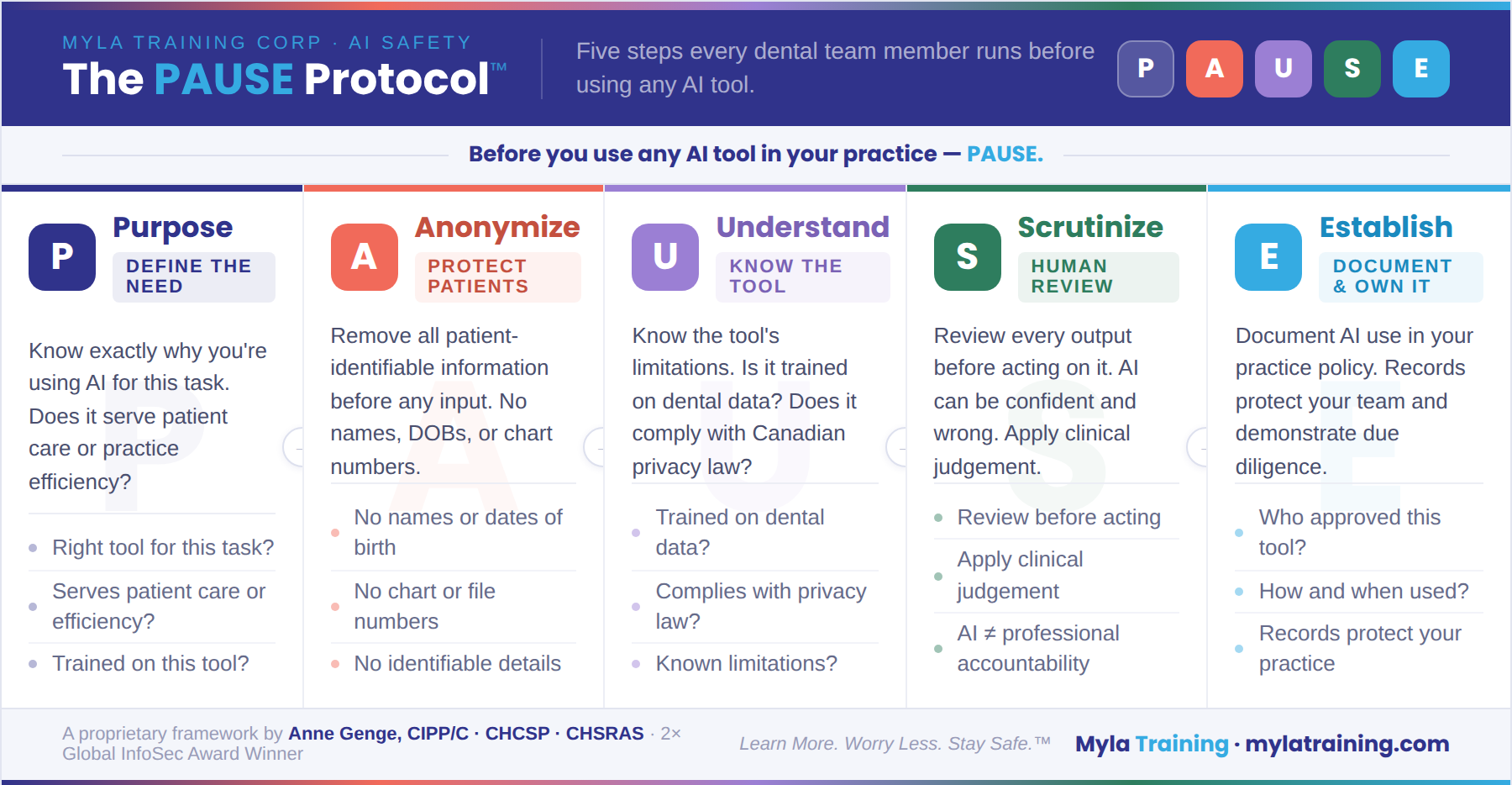
The MYLA PAUSE Protocol™ is a practical AI safety framework created by Anne Genge and owned by Myla Training Corp.
It helps dental teams slow down, think clearly, and use AI with more confidence.
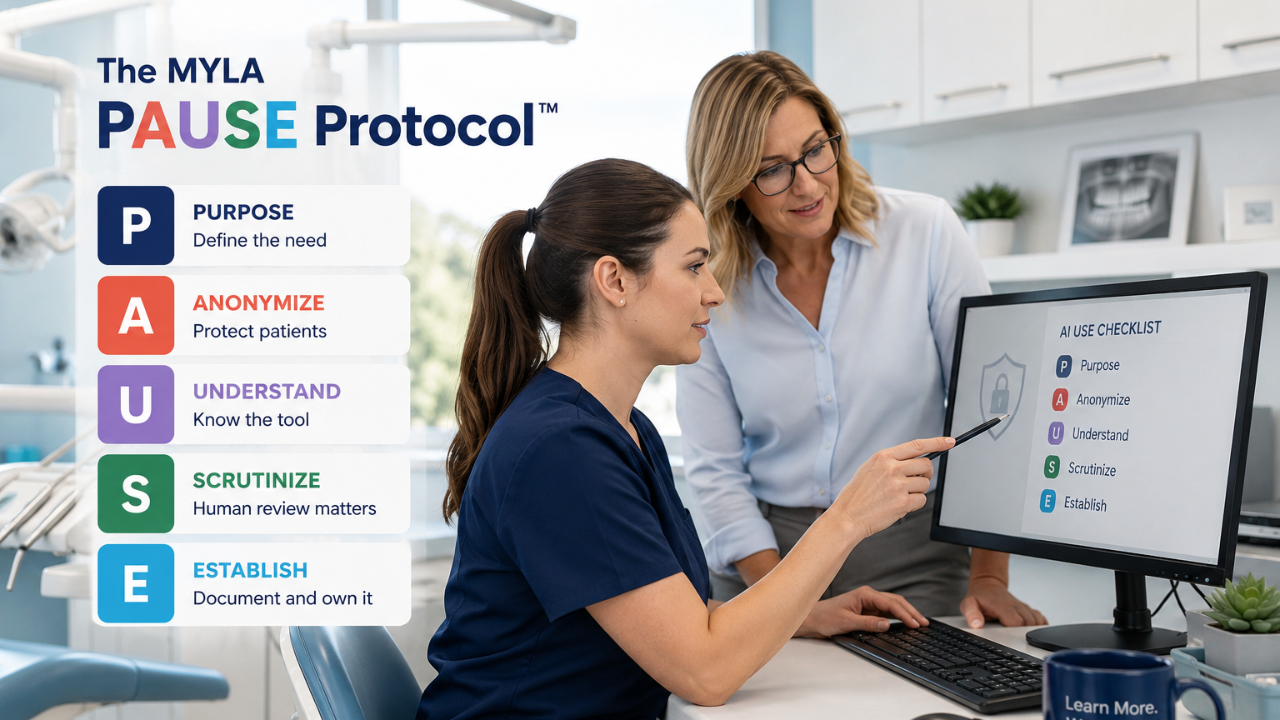
PAUSE stands for:
- P: Purpose
- A: Anonymize
- U: Understand
- S: Scrutinize
- E: Establish
Each step helps address one of the biggest risks in AI use: using powerful tools without clear rules.

P: Purpose
Define the need
Before using AI, ask one simple question:
Why are we using it?
That may sound obvious, but it is one of the most important questions a practice can ask.
AI should not be used just because it is available, trendy, or built into a product. It should be used because it solves a real problem in a safe and appropriate way.
Ask:
- Is AI the right tool for this task?
- Does it support patient care, practice efficiency, communication, or education?
- Is this task clinical, administrative, marketing-related, or operational?
- Could this use affect a patient, a record, a diagnosis, a treatment plan, or a financial decision?
- Should a human handle this instead?
Using AI without a clear purpose creates accidental risk.
One person experiments. Another person copies the process. Someone else uses the same tool with patient information. Before long, the practice has an AI workflow nobody formally approved.
That is not innovation. That is improvisation with a login screen.
Purpose comes first.

A: Anonymize
Protect patients
This is one of the most important rules for dental teams:
Do not enter identifiable patient information into unapproved AI tools.
That includes:
- Names
- Dates of birth
- Chart numbers
- File numbers
- Health card numbers
- Insurance details
- Appointment details that could identify someone
- Photos or radiographs that include identifying information
- Any combination of details that could point back to a specific person
Canadian privacy regulators have specifically warned that organizations using generative AI must consider privacy laws, legal authority, consent, appropriate purposes, safeguards, transparency, and accountability. They also note that prompts and outputs may involve personal information, and that generative AI responses can vary even when prompts are similar.
Source: Office of the Privacy Commissioner of Canada, “Principles for responsible, trustworthy and privacy-protective generative AI technologies”
https://www.priv.gc.ca/en/privacy-topics/technology/artificial-intelligence/gd_principles_ai/
The safest practical rule is simple:
No identifiable patient information in unapproved AI tools.
This one habit can prevent many privacy mistakes before they happen.

U: Understand
Know the tool
Not all AI tools work the same way.
Some tools may store prompts. Some may use data to improve models. Some may allow administrators to turn off training. Some may process information outside Canada. Some may be designed for general public use, while others may be built for healthcare or enterprise environments.
Before using an AI tool in a dental practice, understand:
- What the tool does
- What the tool is allowed to do
- What its limitations are
- Where data may be stored or processed
- Whether prompts, uploads, or outputs may be used for training
- Who has access to the data
- Whether the tool is approved for use with sensitive information
- Whether it is appropriate for a Canadian dental practice
- Whether it has been reviewed before staff use it
The Canadian Centre for Cyber Security notes that generative AI can improve business processes, but it also creates risks involving misinformation, phishing, privacy of data, malicious code, and sensitive information entered into prompts.
Source: Canadian Centre for Cyber Security, “Generative artificial intelligence”
https://www.cyber.gc.ca/en/guidance/generative-artificial-intelligence-ai-itsap00041
Understanding the tool does not mean every team member needs to become an AI engineer.
It means the practice needs enough knowledge to make informed decisions.
If nobody knows where the data goes, whether the output is reliable, or whether the tool is approved for the task, the team is not ready to use it with patient or practice-sensitive information.

S: Scrutinize
Apply human review
AI output should never be accepted automatically.
That is true even when the answer sounds polished, confident, and professional.
Especially then.
AI can produce information that is incomplete, outdated, biased, misleading, or simply wrong. It can also create a tone that sounds appropriate on the surface but does not match the situation, the chart, the patient, or the clinical context.
Review AI output for:
- Accuracy
- Clinical appropriateness
- Privacy concerns
- Missing context
- Unsupported assumptions
- Tone and professionalism
- Alignment with the patient record
- Regulatory or ethical concerns
- Whether a dentist, manager, or privacy lead should review it before use
The Royal College of Dental Surgeons of Ontario has released AI guidance to help dentists use AI ethically, responsibly, and transparently. RCDSO also notes that AI tools may require greater caution and oversight when they involve personal health information or affect clinical care.
Source: RCDSO, “Frequently Asked Questions: Artificial Intelligence in Dentistry”
https://www.rcdso.org/en-ca/standards-guidelines-resources/rcdso-news/frequently-asked-questions/information-on-artificial-intelligence
That is the key point.
AI can assist people.
It does not replace professional judgment.
It does not replace clinical responsibility.
It does not replace accountability.
If AI helps draft something, a human still owns the decision to use it.

E: Establish
Document and own it
Safe AI use should not live in one person’s head.
It should be documented.
Dental practices should establish:
- Which AI tools are approved
- Which tools are not approved
- What each tool may be used for
- Whether patient information is allowed
- Who can use the tool
- Who reviews outputs
- Who is responsible for oversight
- What staff should do if they make a mistake
- How AI-related concerns are reported
- How training is documented
- How policies are reviewed as tools change
NIST’s Artificial Intelligence Risk Management Framework was created to help organizations that design, develop, deploy, or use AI systems manage AI risks and promote trustworthy and responsible AI.
Source: NIST, “Artificial Intelligence Risk Management Framework”
https://www.nist.gov/publications/artificial-intelligence-risk-management-framework-ai-rmf-10
You do not need a complicated system.
You need a system your team can actually follow.
A short policy that is used is better than a long policy that collects digital dust.
Why PAUSE Matters in Dentistry
AI is moving quickly, but dental teams are already busy.
The front desk is managing phones, forms, insurance, payments, and scheduling. Assistants are supporting patient care. Hygienists are documenting, educating, and treating patients. Dentists are making clinical decisions. Managers are handling staffing, compliance, vendors, payroll, and practice operations.
AI enters that environment with a promise:
I can help.
And sometimes it can.
But without rules, AI can also create new risks:
- Patient information entered into the wrong tool
- AI-generated content copied without review
- Inaccurate patient communication
- Unsupported clinical statements
- Policies that sound official but are not correct
- Staff using different tools in different ways
- No documentation of what was used or why
- No clear accountability if something goes wrong
The MYLA PAUSE Protocol™ gives teams a simple way to slow down before risk becomes routine.
It is not about making people afraid of AI.
It is about making safe use easier.
A Simple AI Action Plan for Dental Practices
If your practice is just getting started with AI, keep it practical.
Start here:
- Create an approved AI tool list.
- Decide which tools may be used and for what purpose.
- Create a no-go list.
- Include unapproved tools, patient data misuse, unreviewed outputs, and any task that should not involve AI.
- Set a no-patient-information rule for unapproved tools.
- Assign an AI lead.
- Write a simple AI use policy.
- Define review levels.
- Train the team.
- Review regularly.
This does not need to be overwhelming.
Your team does not need panic.
They need a process.
Where Training Fits
A protocol is only useful if people understand how to use it.
That is why AI training matters.
Dental teams need to understand:
- What AI is
- What AI is not
- What information should never be entered into public tools
- Why prompts and outputs matter
- Why AI can sound right and still be wrong
- How to review AI-generated content
- When to escalate concerns
- Which tools are approved in the practice
- What documentation is expected

If your team is ready for structured support, explore Myla’s training options here:
https://mylatraining.com/training
You can also review Myla’s certification options here:
https://mylatraining.com/certifications
For more practical articles on dental cybersecurity, privacy, and AI, visit the Myla blog:
FAQ: Using AI Safely in Dental Practices
Do dental practices need an AI policy?
Yes. Even a simple AI policy helps create clarity. It should explain which tools are approved, what information may be used, what is off limits, who reviews outputs, and who is responsible for oversight.
Can dental teams use AI with patient information?
Only if the tool has been properly reviewed and approved for that purpose. As a general rule, dental teams should not enter identifiable patient information into unapproved AI tools.
What is the safest first rule for AI use?
Do not enter identifiable patient information into unapproved AI tools. This single rule helps prevent many common privacy mistakes.
Does AI output always need to be checked?
Yes. AI output should be reviewed before it is used, especially if it involves patients, clinical information, privacy, financial decisions, policies, or public communication.
How often should AI training happen?
Training should happen when AI is introduced and should be refreshed regularly as tools, risks, workflows, and privacy expectations change.
Final Thought
AI is already part of dental practice.
The question is not whether dental teams will use it.
The question is whether they will use it safely, thoughtfully, and with enough structure to protect patients, support the team, and maintain professional accountability.
That is why the MYLA PAUSE Protocol™ exists.
Before you use AI, pause.
Define the Purpose.
Anonymize patient information.
Understand the tool.
Scrutinize the output.
Establish the rules.
AI is moving quickly.
Your team does not need to know everything.
They need to know what matters most.
Intellectual Property and Permission Notice
The MYLA PAUSE Protocol™ is a proprietary AI safety framework created by Anne Genge and owned by Myla Training Corp.
All concepts, wording, training materials, graphics, explanations, course content, and related educational resources associated with the MYLA PAUSE Protocol™ are protected intellectual property.
No part of the MYLA PAUSE Protocol™ may be copied, reproduced, adapted, taught, published, distributed, used in training, included in presentations, incorporated into policies, or used for commercial or educational purposes without prior written permission from Anne Genge and Myla Training Corp.
Permission requests must be directed to Myla Training Corp.
© Myla Training Corp. All rights reserved.
MYLA PAUSE Protocol™ is a proprietary framework of Myla Training Corp.

About the Author

Anne Genge is the founder of Myla Training Corp, a Canadian provider of AI, privacy, and cybersecurity training for dental teams. She is a national speaker and educator who helps dental teams use technology safely, protect patient information, and build practical systems that work in real clinical environments.
Learn more at:
Sources
- Office of the Privacy Commissioner of Canada: Principles for responsible, trustworthy and privacy-protective generative AI technologies
https://www.priv.gc.ca/en/privacy-topics/technology/artificial-intelligence/gd_principles_ai/ - Canadian Centre for Cyber Security: Generative artificial intelligence
https://www.cyber.gc.ca/en/guidance/generative-artificial-intelligence-ai-itsap00041 - NIST: Artificial Intelligence Risk Management Framework
https://www.nist.gov/publications/artificial-intelligence-risk-management-framework-ai-rmf-10 - Royal College of Dental Surgeons of Ontario: Frequently Asked Questions, Artificial Intelligence in Dentistry
https://www.rcdso.org/en-ca/standards-guidelines-resources/rcdso-news/frequently-asked-questions/information-on-artificial-intelligence
Train Your Team to Spot AI Risks Today
Featured Training for Dental Teams
Build your team’s cybersecurity, privacy, and AI safety foundation with practical training designed for every team member.
Explore Myla’s essential training bundle and foundational courses.
Recent Posts
What Are Myla Certifications?
Myla certifications are structured, industry-specific credentials designed for dental professionals. They validate that your team has completed practical cybersecurity, privacy, and AI risk training built specifically for dental practices.
NEW - AI Safety Essentials Course
AI is entering healthcare fast. Is your team ready?
This plain-language course helps healthcare teams understand AI privacy and cybersecurity risks, protect patient information, and meet compliance expectations. Includes 7 short modules, a reference guide, final assessment, and a certificate of completion.