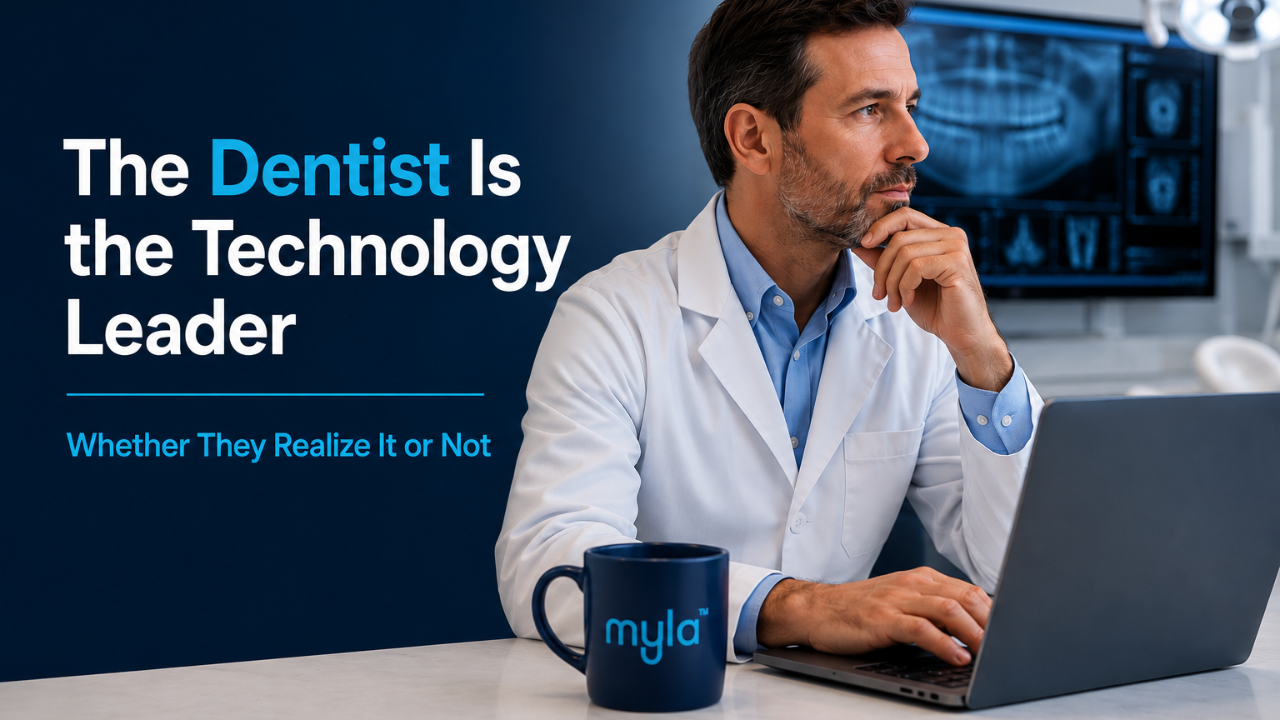
The Dentist Is the Technology Leader - Whether They Realize It or Not
Mar 26, 2026AI Isn't Just Another Software Purchase
Most dentists have been adopting new technology for years. Practice management systems, digital imaging, online booking, cloud platforms, patient communication tools—technology change is nothing new.
That's why AI can be deceptively familiar.
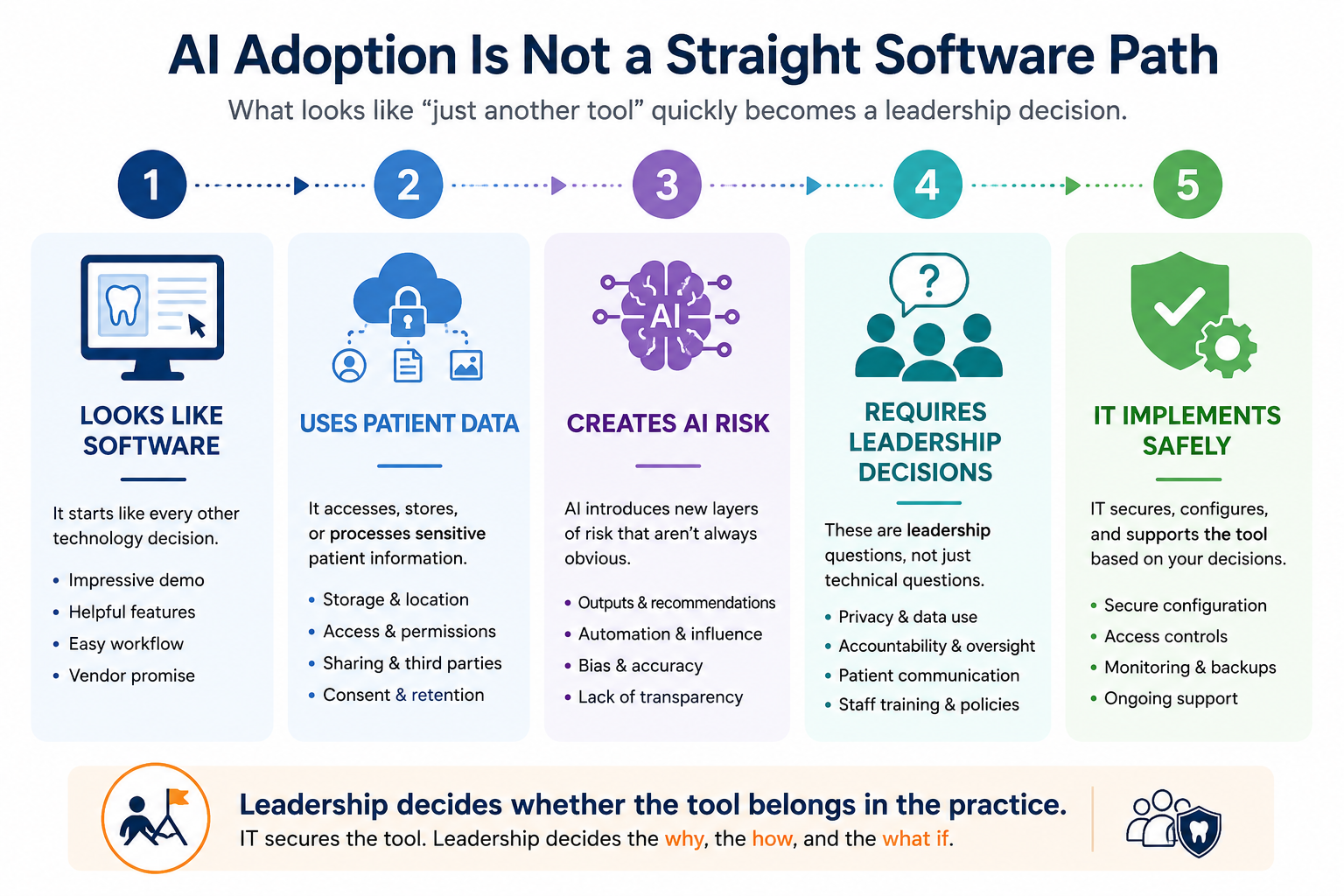
It often arrives as just another feature, another platform, or another vendor promise. But unlike traditional software, AI introduces new questions about patient information, privacy, accountability, oversight, and trust.
The challenge is that many of these questions aren't technical questions. They're leadership questions.
And while your IT provider plays an essential role in securing and supporting technology, they can't decide how patient information should be used, what level of risk your practice is comfortable accepting, or how AI should fit into patient care and communication.
Those decisions belong to practice leadership.
Picture this: a dental practice approves a new AI-powered imaging tool because the demo looked impressive and the workflow seemed easy. Three months later, someone asks where the patient scans are being stored. Nobody knows. The IT provider set it up. The vendor says it is secure. But no one reviewed the data-use terms, no one confirmed whether patient consent was needed, and no one prepared the front desk to answer patient questions about it.
That situation is not unusual. And it is entirely avoidable.
OTHER IMPORTANT READING
Dental AI Essentials: The Myla PAUSE Protocol™: A Practical Framework for Dental Teams
The New Standard for Dental Cybersecurity Training in the Age of AI
Dental technology decisions now include cloud systems, imaging platforms, patient communication tools, online forms, vendor portals, payment systems, and increasingly, artificial intelligence. That changes the leadership question.
IT may help install, secure, configure, monitor, and support technology. But IT does not decide what kind of practice you are building unless you include them in the process. IT does not decide how patient information should be used. IT can't decide for you whether a new AI tool aligns with your privacy obligations, clinical workflow, patient communication standards, or risk tolerance.
That responsibility sits with the dentist and practice owner.
In other words: the dentist is already the technology leader, whether they realize it or not.
Who should lead dental technology decisions?
The dentist or practice owner should lead dental technology strategy. A privacy & cybersecurity professional can help ensure it's compliant, and IT should support that strategy.
That does not mean the dentist needs to become an IT expert. It means the dentist needs enough leadership knowledge to ask better questions, assign responsibility clearly, understand privacy and AI risks at a practical level, and make informed decisions before a new tool becomes part of patient care or practice operations.
Safe technology adoption is not just a technical issue. It is a governance issue.
Before Your Dental Practice Uses AI: A Practical Checklist for Safer Adoption
Technology leadership is not the same as technical support
This is where many dental practices get stuck. They assume that because something involves software, cybersecurity, cloud access, or AI, it belongs entirely to IT.
But modern cybersecurity guidance says otherwise.
Federal and provincial privacy laws, and college guideance as well as Global frameworks speak to accountability and governance. For example, The NIST Cybersecurity Framework 2.0 (1) is designed to help organizations manage cybersecurity risk. Its current framework includes a Govern function, which focuses on strategy, expectations, policy, roles, responsibilities, and oversight - not just technical controls. Source: NIST Cybersecurity Framework 2.0.
That distinction matters in dentistry.
Your IT provider can help answer questions like:
- Is multifactor authentication turned on?
- Is this system patched and up to date?
- Are backups running and tested?
- Are permissions configured properly?
- Is the network protected?
The dentist and practice leadership must answer a different set of questions:
- Should we use this tool at all?
- What patient information will it access?
- Is AI involved, and if so, how?
- Do we understand the vendor's privacy and data-use terms?
- Have staff been trained on safe use?
- What will we tell patients?
- Who is accountable if something goes wrong?
IT secures the door. Leadership decides whether the practice should open it in the first place.
__________________________________________________________________________________________
IT secures the tool. Leadership decides whether the tool belongs in the practice.
__________________________________________________________________________________________
AI makes leadership even more important
Artificial intelligence is showing up at the front desk, in the operatory, and in the consultation room - and not always with a label on it.
AI may be embedded inside imaging tools, patient communication platforms, documentation tools, scheduling systems, marketing platforms, analytics tools, or clinical decision-support systems. Some tools clearly advertise AI. Others include it quietly in the background.
That means dental practices need a new leadership skill: the ability to evaluate technology before it becomes part of daily workflow.
NIST's AI Risk Management Framework was developed to help organizations manage risks to individuals, organizations, and society associated with AI. It is intended to improve the ability to incorporate trustworthiness considerations into the design, development, use, and evaluation of AI products, services, and systems. Source: NIST AI Risk Management Framework.
For dental practices, that means AI adoption should not start with "This looks cool." It should start with:
- What problem are we actually trying to solve?
- What patient data does this tool use or access?
- Is patient consent required?
- Can the vendor clearly explain how data is stored, used, shared, and retained?
- Does the team understand what the tool can and cannot do?
- Who reviews the output before it informs a clinical decision?
- What do we say if a patient asks, "Are you using AI on my information?"
That last question is no longer hypothetical. Patients are beginning to ask it. The practice needs a ready answer.
AI adoption is also a patient communication issue
Policies and procedures are essential - and they are no longer enough on their own.
Dental teams now need to be equipped to talk about AI in a calm, clear, patient-friendly way. Patients may not ask technical questions. But they will ask very reasonable human questions:
- Are you using AI in my care?
- Is my information being sent somewhere?
- Can I say no?
- Is a person still reviewing the results?
- Is this safe?
Those questions should not catch the team off guard.
Practices need agreed-upon plain-language messaging for how AI is explained. The message should be truthful, simple, consistent, and free of defensive or promotional tone. It should also make clear that the dentist remains responsible for clinical decisions.
For example, in Ontario, PHIPA governs the collection, use, and disclosure of personal health information. It requires consent unless the collection, use, or disclosure is otherwise permitted or required under the Act. Source: Personal Health Information Protection Act, 2004.
The Office of the Privacy Commissioner of Canada's meaningful consent guidance says privacy information should be readily available and understandable, and that people should be informed about what personal information is being collected and with which parties it is being shared. Source: Office of the Privacy Commissioner of Canada, Guidelines for obtaining meaningful consent.
In short: patient communication about AI is not a marketing exercise. It is part of privacy leadership.
Dentistry needed a technology framework for better leadership and accountability...so we built it.
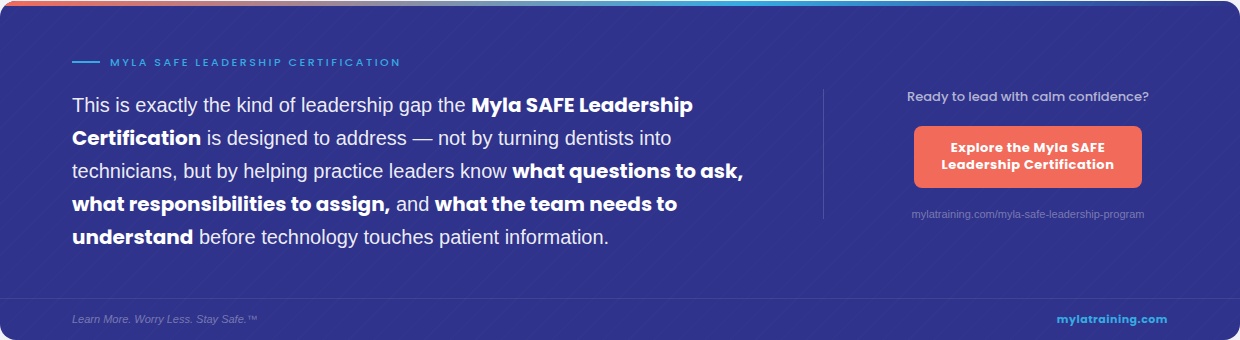
This is exactly the kind of leadership gap the Myla SAFE Leadership™ Certification is designed to address: not by turning dentists into technicians, but by helping practice leaders know what questions to ask, what responsibilities to assign, and what the team needs to understand before technology touches patient information.
A better model: SAFE Technology Leadership™
The Myla SAFE Framework™ gives dental practices a practical structure for thinking about technology leadership. Its four pillars are:
- See the Risk - identify exposure across data, technology, vendors, people, and AI before you act.
- Assign Responsibility - make clear who owns what, from the front desk to the dentist to IT.
- Formalize Safeguards - turn intentions into documented policies, procedures, training, and proof.
- Evaluate and Evolve - build the review cycle that keeps your practice current as technology changes.
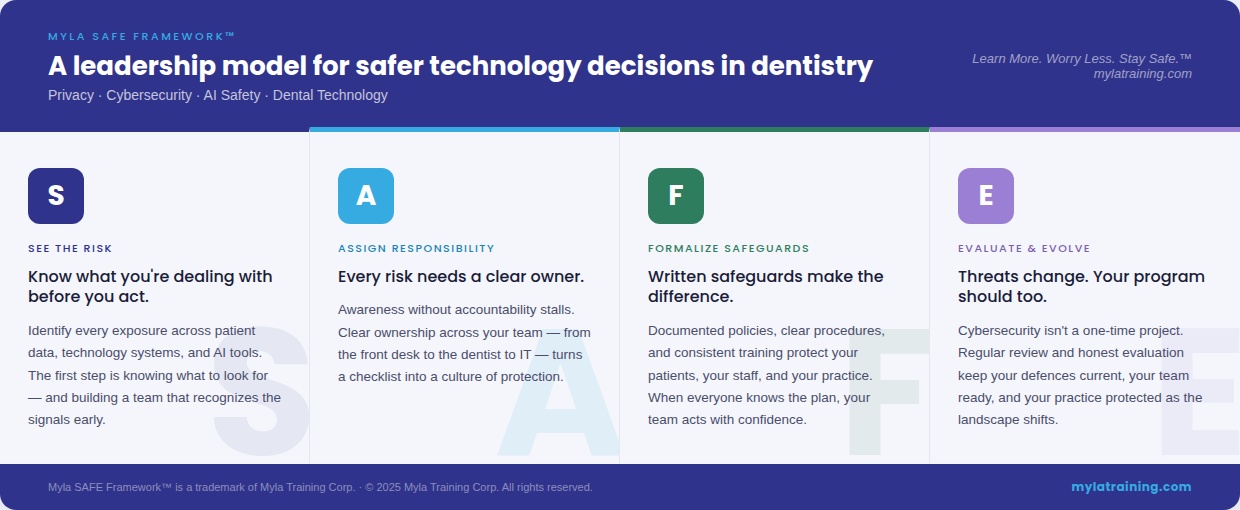
The most important pillar for this discussion is Assign Responsibility. The Myla SAFE Framework™ makes clear that privacy and security are not just the IT person's job. They belong to the whole team, while accountability starts at the top. Source: Myla SAFE Framework™ graphic.
Practices do not need the dentist to become a network engineer. They need the dentist to understand enough about AI, privacy, cybersecurity, and vendor risk to lead the right conversations: what to ask, who to involve, what to document, and when to pause.
Technology responsibility: who owns what?
Use this as a starting point for your own clarity conversation. Every practice is different, but this table makes one thing immediately visible: not every technology decision belongs to IT.
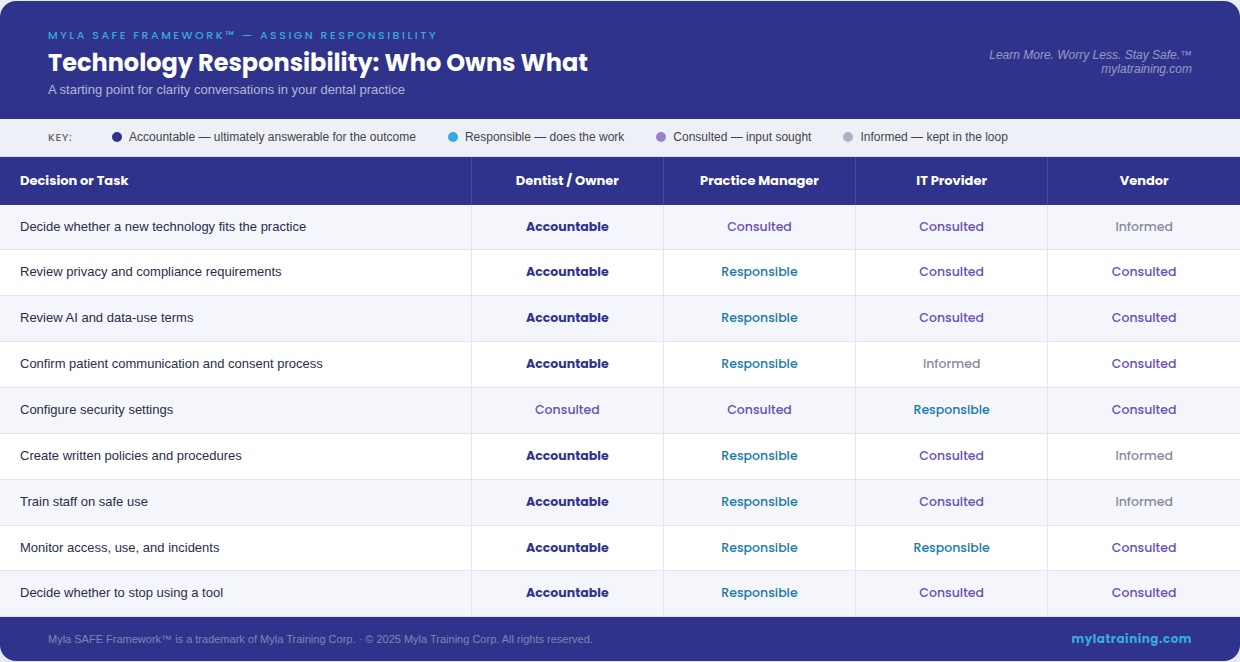
Some decisions are business decisions. Some are privacy decisions. Some are clinical workflow decisions. Some are patient trust decisions. And some are technical decisions.
Safe technology leadership means knowing the difference.
The biggest mistake: delegating accountability
Delegation is necessary. Abdication is dangerous.
A dentist can delegate technical configuration to IT. A dentist can delegate day-to-day policy coordination to a practice manager or privacy officer. A dentist can rely on vendors for product-specific documentation.
What the dentist cannot do is delegate accountability for the practice's technology choices.
That accountability includes:
- Choosing tools wisely and with full information.
- Confirming privacy and security expectations before adoption.
- Ensuring staff are trained before a tool goes live.
- Documenting decisions and the reasoning behind them.
- Preparing the team for patient questions.
- Reviewing technology regularly as the landscape evolves.
- Responding appropriately when something goes wrong.
A dental practice with clear roles is calmer, safer, and easier to manage. Everyone knows what belongs to them. Nothing critical falls into the gap between "I thought IT handled that" and "I thought the office handled that."
That gap is where risk lives. And risk is not exactly known for wiping its feet before it comes in.
Where the Myla SAFE Leadership™ Certification fits
The Myla SAFE Leadership™ Certification is designed for dentists and practice leaders who want to lead technology, AI, privacy, and cybersecurity decisions with more confidence.
It helps practice leaders understand what belongs to IT, what belongs to the dentist, what belongs to the practice manager, and what the whole team needs to know. The goal is not to turn dentists into IT professionals. The goal is to help dentists become better technology leaders.
That means being able to:
- Evaluate new tools before adopting them.
- Ask better vendor questions.
- Understand AI and privacy risk at a leadership level.
- Assign responsibilities clearly across the team.
- Prepare staff for patient communication about AI.
- Document training and safeguards.
- Build a practice culture where technology is useful, safe, and accountable.
Myla SAFE Leadership™ Certification page: mylatraining.com/myla-safe-leadership-program]
Myla Certification Information page: mylatraining.com/certification]
Frequently asked questions
Should IT lead technology strategy in a dental office?
IT should support technology strategy, not lead it. The dentist or practice owner is accountable for choosing appropriate tools, protecting patient trust, assigning responsibilities, and ensuring the team is trained. IT is a critical partner in implementing and securing those decisions.
Are there AI privacy laws for dentists?
AI may involve patient data, automated analysis, vendor data use, consent obligations, and direct patient communication. If an AI tool collects, uses, discloses, stores, or analyzes patient information, it becomes a privacy, governance, training, and trust issue - not just a software decision.
Who should talk to dental patients about AI?
The practice should decide this before questions arise. Staff should have approved plain-language messaging, and more complex questions should be escalated to the dentist, privacy officer, or designated practice leader. Having that conversation planned in advance is part of responsible AI adoption.
What is the first step for safer dental technology leadership?
Start by listing the technologies and AI-enabled tools already in use, identifying what patient data they access, and assigning clear responsibility for review, training, communication, and monitoring. Clarity about what you already have is the foundation for everything else.
Ready to lead with confidence?
Technology leadership in dentistry is no longer optional. The tools are changing too quickly, the privacy expectations are too important, and the patient trust stakes are too high.
Your IT provider is an important partner. The dentist leads the decisions that define the practice.
If your practice is adopting new tools, exploring AI, or trying to clarify who is responsible for what, the Myla SAFE Leadership Certification can help.
Explore the Myla SAFE Leadership Certification and learn how to lead safer decisions around AI, privacy, cybersecurity, and dental technology.

Learn More. Worry Less. Stay Safe.™
Train Your Team to Spot AI Risks Today